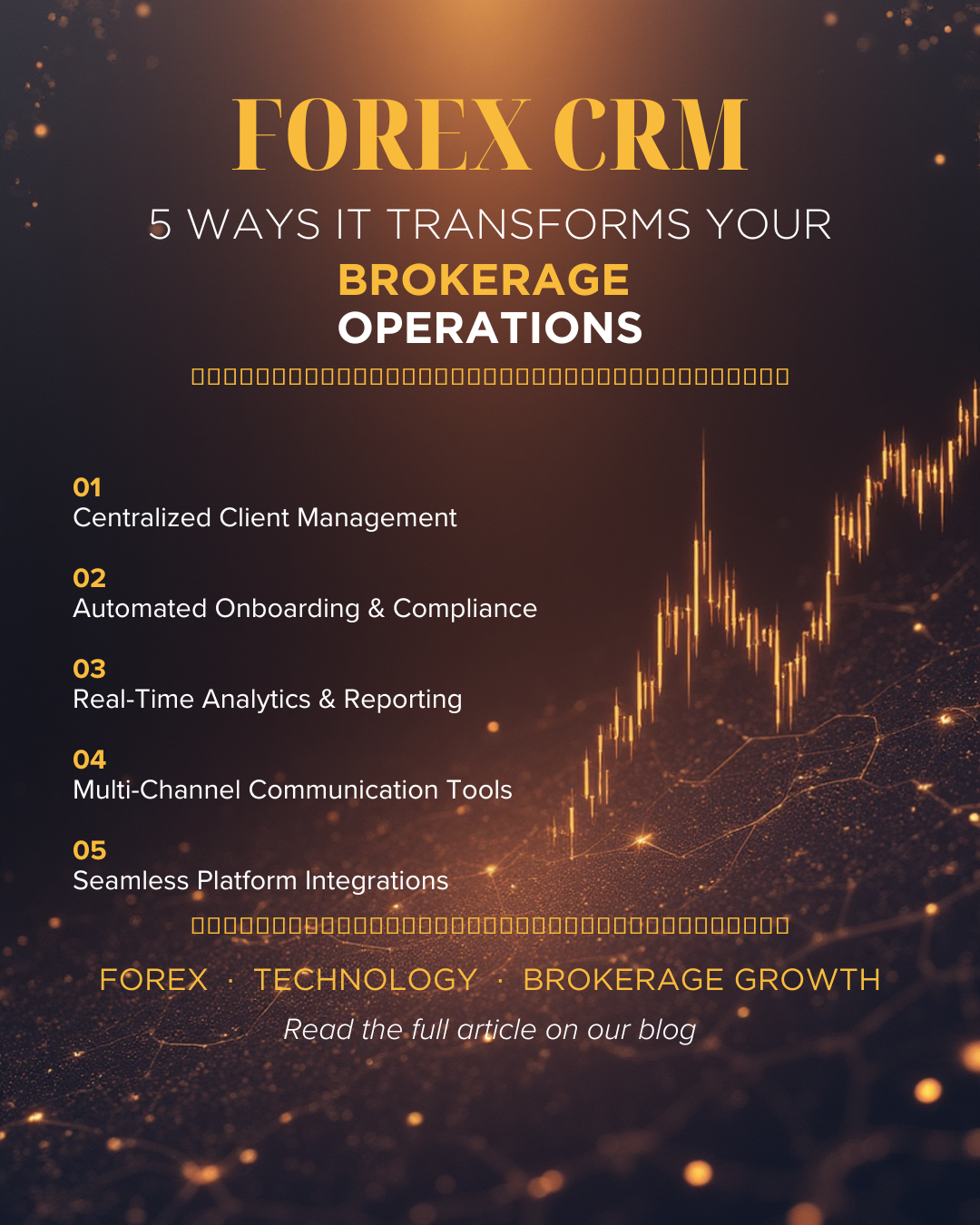
The difference between a brokerage that scales efficiently and one that plateaus at a few hundred clients is rarely the trading platform. It is almost always the operational infrastructure behind the platform — specifically, whether or not the broker has deployed a capable Forex CRM that handles the complex workflows of client management, compliance, revenue operations, and analytics.
In 2026, a Forex CRM is not optional equipment for serious brokers. It is the central nervous system of the business. Here are the five most impactful ways a properly implemented Forex CRM transforms brokerage operations.
1. Automated KYC and Client Onboarding
Regulatory Know Your Customer (KYC) requirements exist in every jurisdiction where retail forex trading is legal. The minimum standard requires verifying a client's identity, confirming their address, and assessing their suitability for leveraged products. Without a CRM, this process involves staff manually reviewing email attachments, maintaining compliance spreadsheets, and following up with clients through generic inboxes. It is slow, error-prone, and nearly impossible to audit efficiently.
A Forex CRM automates every step of this workflow. When a client registers, they are directed to a structured KYC submission portal where they upload their identity documents, proof of address, and complete any required risk questionnaires. The CRM validates document formats, flags issues automatically, and routes submissions to the compliance queue where staff review and approve or reject with a single click.
The measurable impact on onboarding speed
Brokers who implement CRM-automated KYC typically see onboarding time drop from 48–72 hours to under 4 hours for standard residential clients. This matters enormously — research across retail financial services consistently shows that conversion drops sharply with every hour of delay between registration and account activation. A client who waits three days for KYC approval is far more likely to have opened an account with a competitor.
Beyond speed, automated KYC creates a complete, timestamped audit trail for every document submitted. Regulators can see exactly what was submitted, when it was reviewed, and what decision was made — which is exactly what they need during compliance audits or licence renewal reviews.
2. IB and Affiliate Management
Introducing Brokers represent one of the most powerful and cost-effective client acquisition channels in the forex industry. A single experienced IB with a relevant audience can onboard more funded accounts in a month than a brokerage's internal sales team achieves in a quarter. The challenge is managing IB relationships at scale — tracking referrals, calculating commissions, generating performance reports, and paying out accurately on schedule.
Without a CRM, IB management degenerates into manual spreadsheet tracking, periodic disagreements about commission calculations, and delayed payouts that damage IB relationships. The operational overhead is disproportionate to the benefit, which causes many brokers to underinvest in IB programs that should be their primary growth channel.
What CRM-powered IB management looks like
A Forex CRM with a dedicated IB module tracks every referral link, records the registration source for every new client, and automatically attributes trading volume to the correct IB account. Commission structures — whether flat per-lot, revenue share percentage, or tiered volume-based — are configured in the CRM once and applied automatically on every trade.
IBs get access to their own portal, where they can see their referred client list, monitor trading volumes in real time, track commission earnings, and download statements. This transparency builds trust and keeps high-performing IBs loyal to your brokerage rather than constantly shopping for better terms elsewhere.
- Multi-tier IB structures (IB of IBs) tracked automatically
- Real-time commission calculations with no manual reconciliation
- Automated payout schedules — weekly, monthly, or on-demand
- IB performance dashboards for both broker and IB sides
- Marketing material and link management integrated into the IB portal
3. Risk Monitoring and Alerts
Risk management is the discipline that determines whether a brokerage survives market volatility. For B-book brokers, extreme client-side profit events can create significant balance sheet stress. For all brokers, client positions that approach margin call levels require careful monitoring to ensure orderly liquidation processes are triggered appropriately.
Without automated risk monitoring, brokers rely on dealers watching the MT4/MT5 manager terminal — a reactive, human-dependent process that works in normal market conditions but fails during volatile periods when simultaneous issues across dozens of accounts require immediate attention.
How CRM risk monitoring changes the picture
A Forex CRM with integrated risk monitoring continuously pulls position and balance data from MT4/MT5 and applies configurable alert rules. When a client's equity drops below a defined threshold, an alert is generated. When aggregate B-book exposure on a specific instrument breaches a limit, the risk team is notified. When deposit-to-trading ratios suggest unusual account behaviour, flags are raised for review.
These alerts allow the risk team to act proactively rather than reactively — intervening before small problems become large losses. The CRM creates a documented history of risk events and responses, which is increasingly expected by regulators as evidence of robust internal risk governance.
"Risk monitoring is not just about protecting the broker's book. It is about protecting clients from situations they did not fully understand when they opened their positions. A CRM with real-time alerts enables responsible brokerage practice."
4. Client Retention Through Personalisation
Forex brokerages face a structural retention challenge. Clients who experience a string of losing trades are statistically likely to withdraw and either stop trading or move to a competitor. Keeping clients engaged, supported, and motivated through difficult trading periods is one of the highest-value activities a brokerage can invest in — and it is almost impossible to do effectively without CRM-driven personalisation.
A Forex CRM segments clients by their trading behaviour, account tier, deposit history, instrument preferences, and activity level. Based on these segments, automated workflows trigger personalised communications at the right moments:
- A client who deposits but has not yet placed a first trade receives a welcome call prompt and an educational resource email
- A client who has been inactive for 30 days receives a re-engagement campaign with a time-limited deposit bonus
- A client who has just completed their 100th trade receives a loyalty recognition message and an account upgrade offer
- A client whose account balance has dropped significantly receives a risk education communication and an invitation to speak with a support representative
None of these interactions require manual effort once the workflows are configured. The CRM monitors activity automatically and triggers the appropriate communications at scale — creating the impression of a highly attentive, personalised service even when the brokerage has thousands of clients.
5. Revenue Reporting and Analytics
You cannot optimise what you cannot measure. Brokerages that operate without comprehensive revenue reporting are making decisions based on intuition rather than data — which means they cannot identify which client segments are most profitable, which IB channels deliver the best lifetime value, which account types generate the most spread revenue, or where operational inefficiencies are costing them margin.
A Forex CRM brings together data from MT4/MT5 (trading volumes, spread income, open positions), payment processors (deposits, withdrawals, net flows), and CRM activity (KYC status, communication history, IB attribution) into a unified reporting layer. This makes it possible to build reports and dashboards that answer the questions that actually matter:
- What is the average lifetime value of clients referred by IB A versus IB B?
- Which account type generates the highest spread revenue per client per month?
- What is the 30-day retention rate for clients who receive the automated welcome sequence versus those who do not?
- Which deposit methods have the lowest failure rate and the highest average deposit size?
- What is the spread revenue trend by instrument across the last 12 months?
With these insights available, brokerage management can make evidence-based decisions about where to invest in growth, where to reduce operational costs, and which client segments to prioritise. The difference in business outcomes between data-driven and intuition-driven brokerage management is significant — and it widens every month that the data-driven operation accumulates intelligence while the intuition-driven operation stays in the dark.